
jueves, 19 de febrero de 2015

sábado, 7 de febrero de 2015
Roman aqueducts

Ancient Roman aqueducts are some of the most impressive architectural remnants of the once dominant Roman Empire. The technological advances that were made around the first century AD by both the Greeks and Romans in the areas of architecture, construction, and design, were cutting edge to say the very least. There were also quite clearly abundant practical applications for the Roman aqueducts in Rome, Italy. Even as Rome’s population exceeded 1 million people around the year 120 AD, the aqueducts capably and efficiently supplied clean and potable drinking water not only to Rome itself, but also to a number of the large cities and small towns in the Empire, and other points of interest including mines and significant work sites. The history of Roman aqueducts sees a major decline in their use after a series of centuries and the fall of the Roman Empire. For years, however, these water delivery systems were the predominant way of supplying water to vast Empire and its manifold needs.
The Roman aqueducts stretched some 300 miles in the city of Rome, only about 29 miles were above ground. While the builders wanted to make sure that certain stretches of the Roman aqueducts in Rome were above ground to display their innovative and inspiring designs, building aqueducts underground also had its practical advantages, not the least of which was keeping the water clean and free from disease and bacteria. The history of Roman aqueducts is important to understand in order to truly grasp the way in which Rome was organized. Citizenship in the Roman Empire meant the advantages of advantages such as ready access to potable drinking water, certainly not something that could be said for many other, if any, places in the world at this point in history.
There were eleven major ancient Roman aqueducts that were constructed over the course of 500 years. Visitors of Rome are often startled at how large and extensive these constructions are when they see the aqueducts that are well maintained to this day. You can visit impressive aqueducts like Porta Maggiore, the Arch of Druses, and Nero's Aqueduct. What's amazing is that some of the aqueducts, if need be, could still be used. It doesn't cost any money to explore the extant aqueducts in Rome.
If you are visiting Rome, you will also have the ability to visit the remains of one of the major aqueducts just outside the city along the Appian Way. Construction of these aqueducts were started by Caligula in 36 AD and completed by Claudius in 50 AD. History shows that, at one time, the lower tube (Aqua Claudia), supplied nearly two-thirds of all the water going into Rome.
domingo, 18 de enero de 2015
DESIGUALDAD ECONÓMICA DE LOS PAÍSES DEL MUNDO
VIDEO MUY INTERESANTE QUE ME HAN MOSTRADO MIS ALUMNOS DE 3º DE LA ESO QUE TODOS Y TODAS DEBERÍAMOS VER
domingo, 11 de enero de 2015
GOTHIC ART

Virgin and Child Ivory Carving (1280). Gothic sculpture at its finest. Louvre, Paris.
The term 'Gothic' describes the style of European architecture, sculpture (and minor arts) which linked medieval Romanesque art with the Renaissance. The period is generally divided into Early Gothic (1150-1250), High Gothic (1250-1375), and International Gothic (1375-1450). Primarily a form of Christian art, it flourished initially in Cathedrals and churches across the Ile de Franceand surrounding region in the period 1150-1250, and then spread throughout northern Europe.
The chief hallmark of Gothic art was its unique integration of the arts of sculpture, stained glass and architecture - notably, in the great cathedrals of Chartres, Amiens, Reims and Notre Dame de Paris. The planar forms of the previous Romanesque style were replaced by a new focus on line, and its soaring arches and buttresses permitted the opening up of walls for unprecedently huge windows filled with beautifully translucent holy images, far surpassing anything that murals or mosaic art had to offer. All this created an evocative humanistic atmosphere quite different from the earlier Romanesque movement. (During the late 14th and early 15th centuries, Gothic fused with Italian art to produce a more secular style, called International Gothic, as it spread across Burgundy, Bohemia and northern Italy.)
Gothic art, being exclusively religious art, lent powerful tangible weight to the growing power of the Church in Rome. This not only inspired the public, as well as its secular leaders - an important feature especially during times of hardship, such as the Black Death which killed a third of Europe's population during the second half of the 14th century - but also it firmly established the connection between religion and art, which was one of the foundations of the Early Renaissance. Among famous medieval artists in the Gothic style were Giovanni Pisano, as well as Simone Martini of the Sienese School of painting.
viernes, 26 de diciembre de 2014


miércoles, 3 de diciembre de 2014
CONSTITUCIÓN ESPAÑOLA DE 1978
- DON JUAN CARLOS I, REY DE ESPAÑA, A TODOS LOS QUE LA PRESENTE VIEREN Y ENTENDIEREN, SABED: QUE LAS CORTES HAN APROBADO Y EL PUEBLO ESPAÑOL RATIFICADO LA SIGUIENTE CONSTITUCIÓN:
PREÁMBULO
Garantizar la convivencia democrática dentro de la Constitución y de las leyes conforme a un orden económico y social justo.
Consolidar un Estado de Derecho que asegure el imperio de la ley como expresión de la voluntad popular.
Proteger a todos los españoles y pueblos de España en el ejercicio de los derechos humanos, sus culturas y tradiciones, lenguas e instituciones.
Promover el progreso de la cultura y de la economía para asegurar a todos una digna calidad de vida.
Establecer una sociedad democrática avanzada, y
Colaborar en el fortalecimiento de unas relaciones pacíficas y de eficaz cooperación entre todos los pueblos de la Tierra.
En consecuencia, las Cortes aprueban y el pueblo español ratifica la siguiente
CONSTITUCIÓN
domingo, 23 de noviembre de 2014
EL ROMÁNICO DE SANTA MARÍA DE TAHÜLL
ANÁLISIS Y COMENTARIO DE LAS PINTURAS DE SANTA MARÍA DE TAHULL
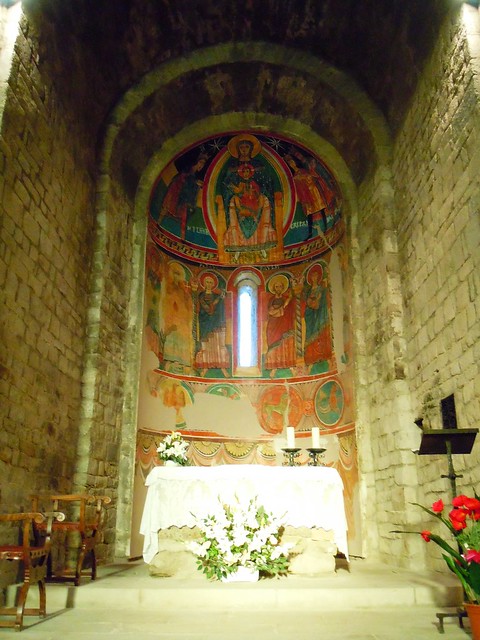
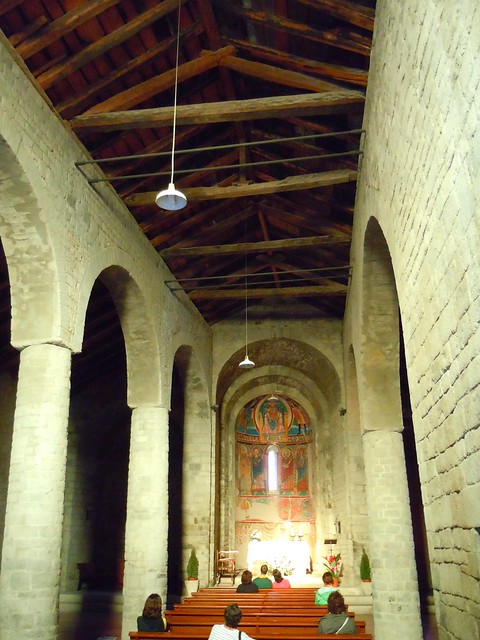
Pintura al fresco del ábside de Santa María de Tahull, Pirineos leridanos. Mediados del siglo XII. En la actualidad se exponen en el Museo de Arte de Cataluña, Barcelona.
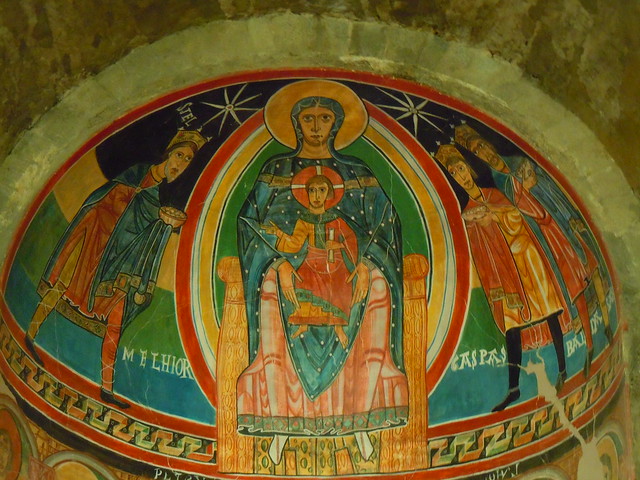
El tema representado es la Maiestas Mariae , iconografía bizantina derivada de la Virgen Kiriotissa. En ella, la Madre sirve como trono del Hijo, rodeados ambos por la mandorla mística. Cristo, con el pergamino de la Ley en la izquierda, bendice con la derecha mientras recibe el homenaje de los Reyes Magos (Epifanía). Estos llevan las ofrendas con las manos veladas en señal de respeto, iniciando Melchor una genuflexión o proskinesis ante la divinidad. Sobre sus cabezas aparecen las estrellas del relato evangélico.

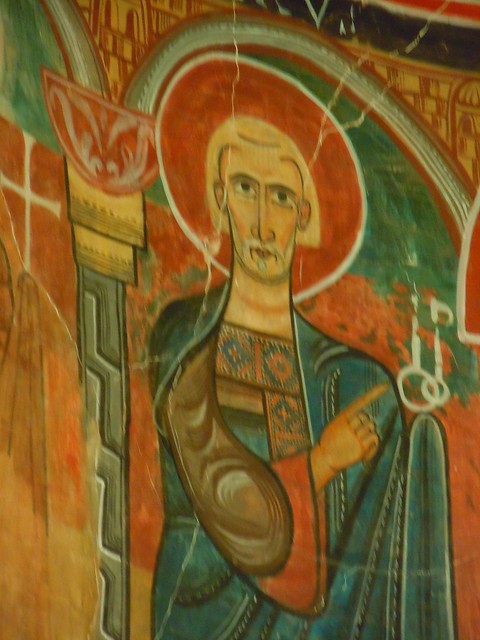
En la zona inferior aparece, bajo una galería de arcos, el ColegioApostólico compuesto, de izquierda a derecha, por: San Andrés (¿?), San Pedro con su pelo blanco, San Pablo, representado (como es habitual) calvo, y San Juan Evangelista que sostiene su libro con la mano velada, señalándolo con el dedo.
La división entre ambas zonas se realiza a través de una cinta continua representada de forma zigzagueante en perspectiva.


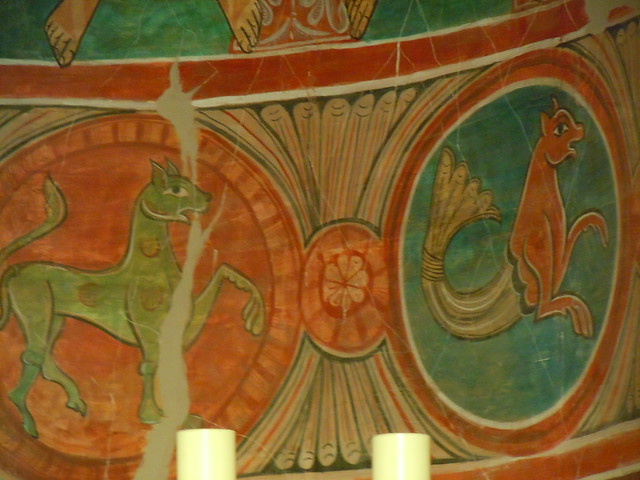
Por dejado de estos dos, aún existe un tercer registro ocupado por clípeos con un bestiario fantástico y, bajo ellos, unos cortinajes figurados
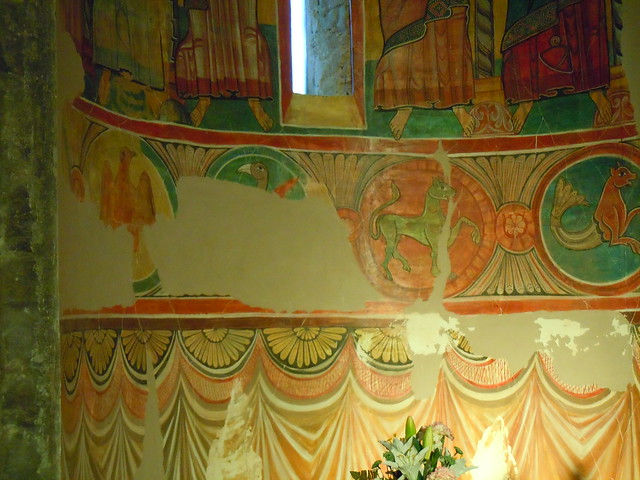
La técnica empleada es el fresco sobre revoco de yeso y con retoques al temple.
La composición es simétrica y adaptada al marco. El eje, tanto visual como temático, es la Virgen con el Niño en la parte superior, utilizando la ventana real del ábside (aunque integrada en la composición general) en la zona inferior. A ambos lados se desarrollan figuras en paralelo que en el Colegio Apostólico son organizadas por medio de recursos arquitectónicos (arquería simulada). Junto a la Virgen , y debido al número impar de los personajes, el autor recurre a una serie de recursos para equilibrar la imagen. Entre ellos se destaca la postura de piernas abiertas de Melchor que, en espacio, ocupa la misma zona triangular de Gaspar y Baltasar. Por otra parte, el leve giro de Cristo, bendiciendo hacia nuestra izquierda, refuerza visualmente esta zona, dejando ambas partes equilibradas.


El dibujo, como es habitual en la época, resulta fundamental en la creación de la imagen. Para los perfiles se utilizan líneas gruesas que separan las figuras y delimitan los distintos campos cromáticos. También son empleadas con cierta frecuencia las líneas paralelas muy juntas en los pliegues que intentan generar, aunque sea de una forma bastante más mental que visual, claroscuros en los paños. En bordados y arquitecturas fingidas aparece un mayor detallismo a la hora de representar pedrerías y adornos fuertemente influidos por la estética bizantina y las obras contemporáneas de orfebrería.


Por lo general, se busca un fuerte rigor geométrico en todo el dibujo, prescindiendo del detalle en favor de trazos simples y amplios.
El color es plano y sin tonalidades que sólo se consiguen a través de las líneas paralelas ya citadas. Suelen aparecer muy saturados, entre otras causas debido a la escasa iluminación que tendrían estas iglesias en el momento en el que se decoran.
Alguno de estos colores responden a un objetivo simbólico (el rojo y el azul del manto mariano que representan la pasión y la soledad, respectivamente), apreciándose también una intención estética a la hora de combinarlos, como se puede ver en la alternancia de los nimbos del Colegio Apostólico o los colores cruzados que se usan en el grupo central en el que la túnica del Hijo repite, sobre un fondo azul, el manto inferior de la Virgen. De esta manera, y sin romper el bloque único que componen Madre e Hijo conseguido por el bloque cerrado y el ritmo cromático, existe una diferenciación de ambos personajes.

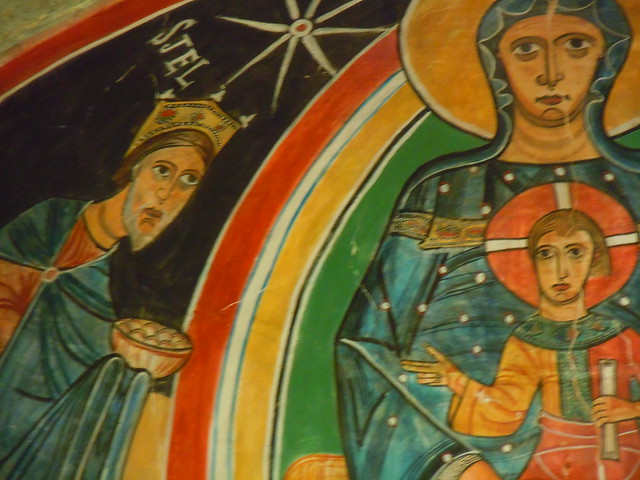
La luz, como también es norma en la época, es casi inexistente. En el románico no se utilizan los conceptos de la luz ambiente o foco lumínico, pues los personajes se sitúan en el espacio atemporal de lo divino, fuera de las experiencias ópticas. Sólo en los ya citados plegados o en ciertas zonas de manos y caras existe un tímida intención de crear claroscuros, de nuevo más mentales que visuales.
En lo referente a la perspectiva, no existe interés por representar elespacio de una forma real. Los fondos son planos, utilizándose el recurso de bandas de colores que ya se empleaba en los beatos mozárabes. En la zona inferior, la arquitectura pintada también resulta plana e ilógica en lo constructivo, con capiteles florales sobrepuestos al arranque de los arcos. Sólo en la greca que separa ambos ambientes nos encontramos con un intento de representación tridimensional, aunque con ciertos errores.

Frente a lo dicho (anulación del espacio y sus relaciones), resultan evidentes las convenciones jerárquicas en cuanto a los tamaños, apareciendo la Virgen mucho mayor, aunque se encuentre sentada, que los Reyes Magos. Su función es mostrar la importancia de los distintos personajes de una forma evidente, sin necesidad de otro tipo de análisis.
En cuanto a las figuras, son las suyas figuras frontales e hieráticas, sin intención de expresión ni volumetría. Se trata de una herencia bizantina en donde el autor, más que representar personas reales, trabaja con arquetipos, con ideas visuales fuera de lo temporal y cotidiano. Sus convencionalismos proceden de su ámbito divino, expresamente lejano del mundo real en donde vive el fiel.
COMENTARIO.
La obra que analizamos responde a la perfección a los modos e ideología de la época románica. Estos, como es sabido, no pretenden larepresentación naturalista del mundo, sino al contrario, buscan una funcióndidáctica para el pueblo analfabeto. De resultas de ello, existe unarenuncia tanto a la belleza como a la representación realista, eliminando claroscuros, uso de la perspectiva, cánones correctos e, incluso, expresiones. Se busca una imagen pedagógica de lo divino, utilizándose formas y maneras que logren transmitir su inmutabilidad (hieratismo) e importancia (convenciones jerárquicas).

Como origen de esta estética de lo trascendente, estos artistas románicos vuelven sus ojos al mundo bizantino y al prerrománico (y en general, en las artes arcaicas) , recogiendo, tanto sus iconografías como su estilística. De ellos también extraen la idea del arte como imagen de lo teológico que no se complace en las apariencias visuales sino que las considera como un simple medio para transmitir ideas religiosas y morales (Argullol lo pone en contacto con la adopción del modelo neoplatónico por parte de San Agustín, con el desprestigio de la realidad frente a la idea, en este caso religiosa)
Es un arte al servicio del mensaje, condicionado a él de tal manera que llega a prescindir de técnicas y conocimientos por el propio hecho de no desviar la mirada a aspectos puramente técnicos. (Esta será la herencia que, sin ningún elemento religioso, se volverá a recoger en el arte contemporáneo, como Picasso en las Señoritas de Avignon, renunciando al realismo)
Es un arte al servicio del mensaje, condicionado a él de tal manera que llega a prescindir de técnicas y conocimientos por el propio hecho de no desviar la mirada a aspectos puramente técnicos. (Esta será la herencia que, sin ningún elemento religioso, se volverá a recoger en el arte contemporáneo, como Picasso en las Señoritas de Avignon, renunciando al realismo)
De esta preeminencia de lo significativo frente a lo formal, surge sufuerte carga simbólica en donde cada cosa se convierte en un símbolo de lectura teológica que luego los sermones, al igual que ocurría en la escultura, terminaba por especificar. De esta manera el nimbo significaría el carácter divino del que lo lleva, reservándose el crucífero a Cristo o las manos veladas la importancia religiosa del objeto (Evangelio en la figura de San Juan, en el Colegio Apostólico). Incluso las propias arquitecturas, según algunos autores, podrían ser interpretadas como una referencia a la Jerusalén Celeste presente en el Apocalipsis.

Para el hombre románico, fuertemente influido por el mensaje eclesiástico, el mundo es una conjunción de símbolos de lo divino que es necesario descodificar. Este papel le corresponde a la Iglesia que, además de transmitir contenidos religiosos, los entremezcla con otros morales quereafirman la situación dominante basada en lo estamental. Los sermones e imágenes abundan constantemente en una imagen de la sociedad basada en categorías cerradas (estamentos) con funciones precisas (nobleza, la defensa; clero, el rezo; no privilegiados el trabajo) que ha de respetarse por su origen divino. Se pretende así una obediencia a las jerarquías que se trasladaría de lo divino (véase la genuflexión de Melchor ante Cristo) a lo cotidiano (del siervo ante su señor eclesiástico o laico) como algo propio del plan divino que Dios ha establecido sobre el mundo
Para todo este control ideológico del pueblo se suele recurrir habitualmente almiedo generado por el castigo. En este sentido es habitual las referencias al fin del mundo (Apocalipsis representado en la imagen por el Cristo como Juez o Pantocrator) o al infierno.
Para todo este control ideológico del pueblo se suele recurrir habitualmente almiedo generado por el castigo. En este sentido es habitual las referencias al fin del mundo (Apocalipsis representado en la imagen por el Cristo como Juez o Pantocrator) o al infierno.
Ambas lecturas aparecen en las pinturas de una iglesia casi contigua a la que analizamos. Nos referimos a San Clemente de Tahull en donde aparece representado la visión apocalíptica de Cristo rodeado por el Tetramorfos, obra de un artista cercano al de Santa María, acaso de su mismo taller que procedería de las zonas del norte de Italia en donde se estaba gestando, bajo modelos bizantinos, esta estética románica.

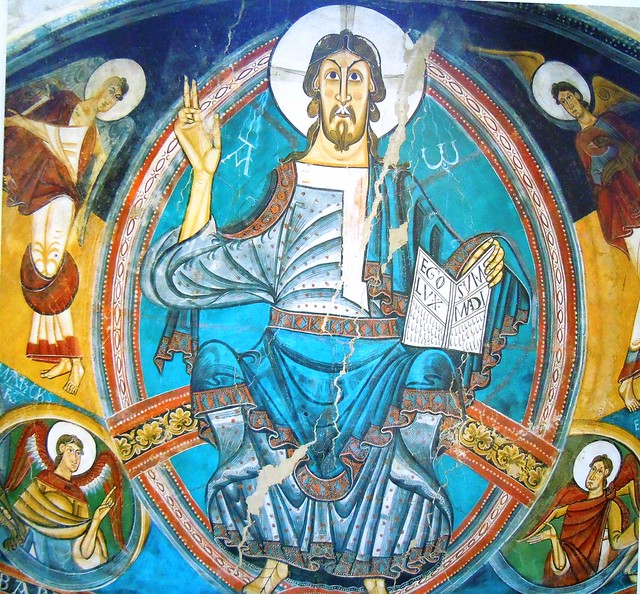
Pantocrator de San Clemente de Tahull
.
De la misma manera se encuentra emparentado con las pinturas murales de Maderuelo o San Miguel de Gormaz, de lectura iconográfica más compleja pero estilo relacionado, lo cual ha hecho pensar a algunos especialistas la misma mano en ambos conjuntos o, al menos, el mismo taller, uno de los más importantes de influencia italiana en la Península.
sábado, 8 de noviembre de 2014
Largest Pottery Workshop of Greek Antiquity Found

German archeologists have discovered the largest industrial quarter of the Greek world, during an excavation in Sicily.
Streching for more than 3,200 feet, the craft district relied on about 80 kilns for the production of ceramics.
“The largest one is 17 feet in diameter, making it the biggest kiln ever found in a Greek city,” Martin Bentz, an archeologist at the University of Bonn, told Discovery News.
The finding was made in the periphery of Selinunte, on the southwest coast of Sicily.
The farthest west of the Greek colonies, known for its grand temples, Selinunte enjoyed centuries of prosperity before being reduced to rubble by the Carthaginians during the first Punic War.
Located along the river Cottone, now silted up, the industrial quarter operated inside the city walls.
“It was separated from the rest of the city by an non-built-up area so to protect the inhabitants from fire danger, smell and noise,” Bentz said.
Bentz’s team made long trenches to reach the end of the workshop and noticed it’s one big homogeneous construction built on four terraces on the slopes of the city hill.
The industrial quarter featured a central courtyard for drying the products before firing, two large working and firing areas and, at the end toward the city, a shop to sell the products.
“The whole construction is more than 3,900 square feet, by far the largest workshop we know in the Greek world,” Bentz said.
The quarter and the workshop were founded around 550 B.C. At that time, the production focused on small artistic terracotta statuettes.
Around the middle of the 5th century B.C., the new huge structure was built, beginning a mass production of roof tiles and vases of every kind.
The workshop was destroyed when the Carthagians conquered Selinus, as the Greeks called it, in 409 B.C.
“We have a thick ash layer which covered the structures and which can be well dated by coins,” Bentz said.
Begun four years ago, the excavation is scheduled to continue until 2016 at least.
jueves, 16 de octubre de 2014
ORIGINS OF BOURBON DYNASTY IN SPAIN
Bourbon dynasty: from1700
Charles II dies in November 1700, leaving the entire Spanish inheritance to a member of the Bourbon dynasty - Philip, a younger grandson of Louis XIV. The resulting European war takes place largely in the Netherlands, Germany and northern Italy. Within Spain itself, where the 18-year-old king arrives in 1701 as Philip V, there is at first relative calm. Philip wins immediate support in the central regions of the kingdom.
But from 1704 the allies (those fighting for the Habsburgs against the Bourbons in this dynastic war) begin to make inroads on the peripheral areas of Spain.
Gibraltar is captured in 1704. In the following year the regions of the north and east (Aragon, Catalonia, Valencia) declare themselves for the Habsburg cause and are occupied by imperial troops - who even advance far enough to seize Madrid for two months during the summer of 1706.
Thereafter the Bourbon forces steadily regain control, starting with a major victory at Almansa in 1707. A succesful campaign in 1710 leaves Philip V in control of the whole of the Spanish kingdom except Catalonia - a region long inclined to independence and doing its best to seize this opportunity.
The eventual terms of the peace, agreed at Utrecht in 1713, confirm Philip V's tenure of the Spanish throne and his rule also over Spanish America (but the Spanish possessions in the Netherlands and northern Italy go to the Habsburgs).
The immediate effect of the change of dynasty in Spain is that the court and government become dominated by French advisers, sent south by Louis XIV to secure his grandson's rule. In many ways this represents an improvement, since French bureaucracy is superior to that of Spain. Moreover the support of outlying regions for the Habsburg cause provides a welcome pretext for centralization, removing the traditional liberties still enjoyed by these medieval Spanish kingdoms.
In other respects the arrival of Philip makes relatively little difference to Spain. Exceptionally religious by nature, he is at ease among the rigours of Spain's Catholicism. During his reign the Inquisition conducts as many as 728 autos-da-fé, imposing on heretics some 14,000 sentences of varying degrees of severity.
In imperial and commercial concerns Philip also follows the policy of his predecessors. Trade with the Spanish colonies is still reserved for Spanish ships, prompting massive smuggling by other maritime powers and frequent skirmishes in the Caribbean - as in the case of Jenkins' Ear, which leads to war with Britain.
Read more: http://www.historyworld.net/wrldhis/PlainTextHistories.asp?groupid=1764&HistoryID=ab50>rack=pthc#ixzz3GJ1xuZER
Charles II dies in November 1700, leaving the entire Spanish inheritance to a member of the Bourbon dynasty - Philip, a younger grandson of Louis XIV. The resulting European war takes place largely in the Netherlands, Germany and northern Italy. Within Spain itself, where the 18-year-old king arrives in 1701 as Philip V, there is at first relative calm. Philip wins immediate support in the central regions of the kingdom.
But from 1704 the allies (those fighting for the Habsburgs against the Bourbons in this dynastic war) begin to make inroads on the peripheral areas of Spain.
Gibraltar is captured in 1704. In the following year the regions of the north and east (Aragon, Catalonia, Valencia) declare themselves for the Habsburg cause and are occupied by imperial troops - who even advance far enough to seize Madrid for two months during the summer of 1706.
Thereafter the Bourbon forces steadily regain control, starting with a major victory at Almansa in 1707. A succesful campaign in 1710 leaves Philip V in control of the whole of the Spanish kingdom except Catalonia - a region long inclined to independence and doing its best to seize this opportunity.
The eventual terms of the peace, agreed at Utrecht in 1713, confirm Philip V's tenure of the Spanish throne and his rule also over Spanish America (but the Spanish possessions in the Netherlands and northern Italy go to the Habsburgs).
The immediate effect of the change of dynasty in Spain is that the court and government become dominated by French advisers, sent south by Louis XIV to secure his grandson's rule. In many ways this represents an improvement, since French bureaucracy is superior to that of Spain. Moreover the support of outlying regions for the Habsburg cause provides a welcome pretext for centralization, removing the traditional liberties still enjoyed by these medieval Spanish kingdoms.
In other respects the arrival of Philip makes relatively little difference to Spain. Exceptionally religious by nature, he is at ease among the rigours of Spain's Catholicism. During his reign the Inquisition conducts as many as 728 autos-da-fé, imposing on heretics some 14,000 sentences of varying degrees of severity.
In imperial and commercial concerns Philip also follows the policy of his predecessors. Trade with the Spanish colonies is still reserved for Spanish ships, prompting massive smuggling by other maritime powers and frequent skirmishes in the Caribbean - as in the case of Jenkins' Ear, which leads to war with Britain.
Read more: http://www.historyworld.net/wrldhis/PlainTextHistories.asp?groupid=1764&HistoryID=ab50>rack=pthc#ixzz3GJ1xuZER
sábado, 13 de septiembre de 2014
HISTORY OF SPAIN
The history of Spain is one of the most fascinating in the world and Spanish history and culture has helped to shape the modern world into what it is today. Although Spain is a relatively small territory located in southwestern Europe, the history of Spain is of grandeur and is strikingly different from that of the rest of the continent.
The timeline of Spanish history tells the story of a land that has been sought after by many civilizations: the Carthaginians and Romans fought over it, the Arabs conquered it and the Catholic monarchs would recover Spain and convert it into the most powerful empire in the world upon the discovery of America. The Spanish Empire reached its peak under King Felipe II, who unified the Spanish territory and lands: from the Philippines to the Americas as well as Portugal, the Netherlands, Italy and some of present day Germany.
From this moment forward, Spain’s history reached a period of economic and political decadence which was accompanied by both foreign and civil wars. The 19th century would mark an important part of Spanish history with the loss of important Spanish territories and the collapse of the Spanish Empire. The independence achieved by Spanish territories in the Americas, Cuba, Puerto Rico and the Philippines significantly shaped the world and modern Spanish history.
Browse through this Spanish history timeline of links to learn more about the history of Spain and the role that Spain has played in the “theatre” of world history. The more you understand Spain’s history and culture, the faster you will love to life in Spain.
Suscribirse a:
Entradas (Atom)